Today marks more than just a new month for manufacturers and logistics hubs in Mississauga, Brampton, and Vaughan. It is the official "Day 1" of the 2026–2027 MLITSD Compliance Initiatives.
If your facility has been coasting on last year’s safety protocols, it’s time for a rapid audit. The Ministry’s focus is shifting, and the cost of non-compliance just got significantly higher.
1. The New Enforcement Tool: Administrative Monetary Penalties (AMPs)
As of January 1, 2026, inspectors have been empowered with a new scheme of Administrative Monetary Penalties. Unlike traditional fines that require a lengthy court process, an inspector can now issue a "ticket" on the spot for specific contraventions of the Occupational Health and Safety Act (OHSA).
The Shift from "Education" to "Enforcement" Historically, MLITSD inspectors focused on "orders" to fix issues. However, the 2026 fiscal year marks a definitive shift. AMPs are non-negotiable financial hits:
- For Individuals: Fines can start at $250 to $500 for basic PPE or smoking violations.
- For Corporations: Penalties for failing to provide a safe workplace or neglecting equipment maintenance can scale into the thousands per day until the issue is rectified.
By utilizing a staffing partner like Alliance, you ensure that every temporary worker has a "Compliance Folder" ready to show the inspector, potentially saving your facility thousands in "on-the-spot" tickets.
2. Priority #1: The "Vulnerable Worker" Initiative
The 2026–2027 inspection cycle puts a spotlight on Vulnerable Workers. In the GTA industrial sector, the MLITSD defines this as:
- New Hires: Anyone on the job for less than six months.
- Temporary Help: Workers placed via staffing agencies.
- Language Barriers: Workers who may not fully comprehend safety instructions provided only in English.
Inspectors will be looking for proof of standardized training and, more importantly, supervisory accountability. They will ask: "Did the supervisor actually observe this new worker operating the equipment safely before they started their shift?"
3. Occupational Hygiene & WHMIS 2026
Building on the momentum of last year, the Ministry is continuing its deep dive into chemical exposures and updated WHMIS standards.
- The Check: Are your Safety Data Sheets (SDS) the latest versions?
- The Training: Have your workers been re-trained on the amended Hazardous Products Regulations?
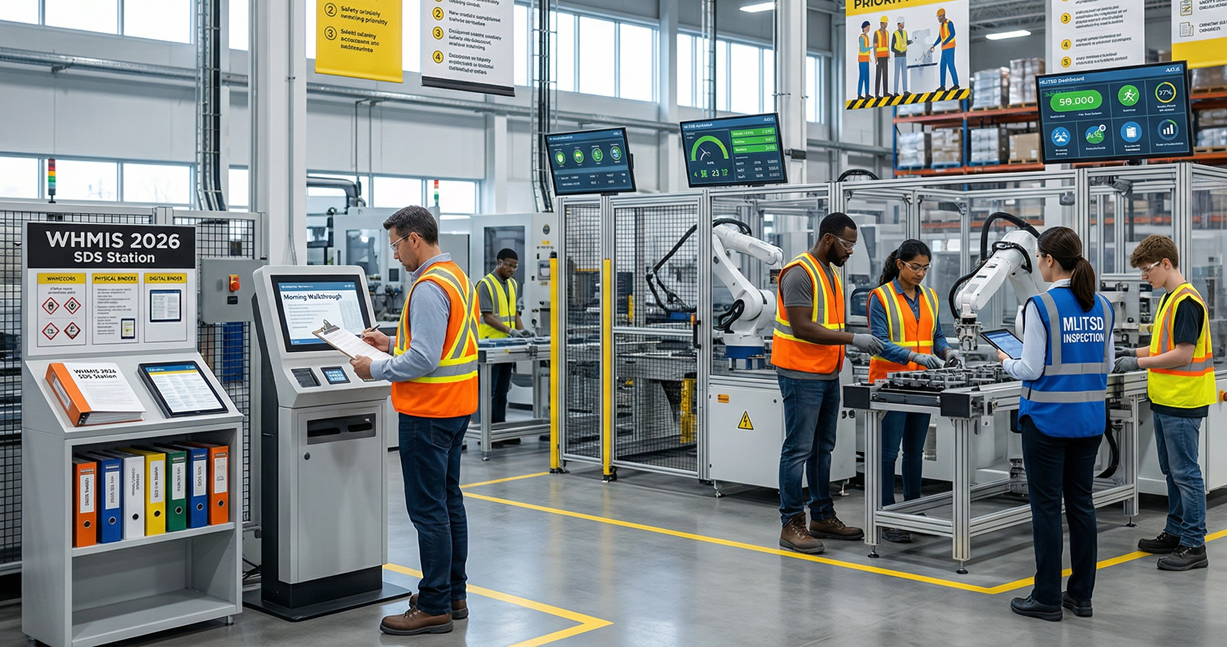
4. Proactive Compliance: The Supervisor’s 5-Minute "Morning Walkthrough"
Before the first shift starts this week, ensure your supervisors perform this "Rapid Audit" to catch red flags before an inspector does:
- The "New Face" Check: Identify every worker on the floor for less than 30 days. Do they have a mentor assigned?
- The Guarding Test: Are all machine guards in place and interlocks functioning? (A top priority for the 2026-2027 cycle).
- The SDS Station: Is the WHMIS binder accessible, and does it contain 2026-compliant Safety Data Sheets?
- Language Verification: Can every worker explain the "Right to Refuse Unsafe Work" in their own words?
The Bottom Line: Your Compliance is Our Priority
Between managing production quotas and navigating the new 2026 Administrative Monetary Penalties, GTA plant managers have enough on their plate. You shouldn't have to stay up at night wondering if a temporary worker’s training record will pass a surprise inspection.
When you partner with Alliance Employment Services, that burden shifts to us. We handle the documentation, the standardized safety orientations, and the "Vulnerable Worker" protections mandated by the Ministry. You get the labor you need; we provide the peace of mind you deserve.
Don't wait for the inspector to knock. Speak with an Alliance Specialist Today and discover how our "Safety-First" staffing model can protect your margins and your people this year.