


The Evolution Gap: Why Confusing Emergency Staffing with Temp-to-Perm Pipeline Building Drives Client Frustration
- Staffing agencies have changed. They used to send day labour. Now most also help build permanent teams. Client expectations have not always kept up. We call that the evolution gap.
- An emergency fill and a temp-to-perm fill are two different orders. One protects today's shift. The other builds your bench.
- Most complaints about worker quality come from judging the first order by the standards of the second.
- Give each type of order its own name and its own notice period. That fixes most of the problem, and you do not have to change agencies to do it.
- We own order completion. You own visibility. Even a rough forecast lets us recruit ahead of your demand instead of behind it.
- Peak season starts building in September. The next few weeks are when planning is still cheap.
Why did staffing's evolution create an expectations gap?
For years, plants in Mississauga, Brampton and Vaughan called a temp agency for one reason: cover a sick call, a vacation, or a busy week. The order was simple. So was the test. Did the shift run?
That is no longer all we do. Most agencies now also build permanent teams through temp-to-perm programs. Many clients use both services from the same provider.
The service grew. Expectations did not always grow with it. That is the gap.
Here is how it shows up. You call at 4:00 PM. You need extra hands for tomorrow's first shift. We fill it. Then those workers get judged on things the order never covered: are they career-minded, do they fit the culture, will they still be here in three years?
Judged that way, a shift we filled correctly looks like a shift we got wrong.
This is almost never about how good the workers are. It is two different orders being measured the same way.
| The old model | What most agencies do now | |
|---|---|---|
| Focus | Day labour and vacation cover | Emergency cover and building permanent teams |
| Goal | Keep the line running today | Keep it running today, and keep people longer |
| What clients expect | The shift gets covered | Often mixed up between the two |
| Where it goes wrong | Rarely. Everyone knew the test | Rush orders get judged on culture fit |
What is the difference between an emergency fill and a temp-to-perm fill?
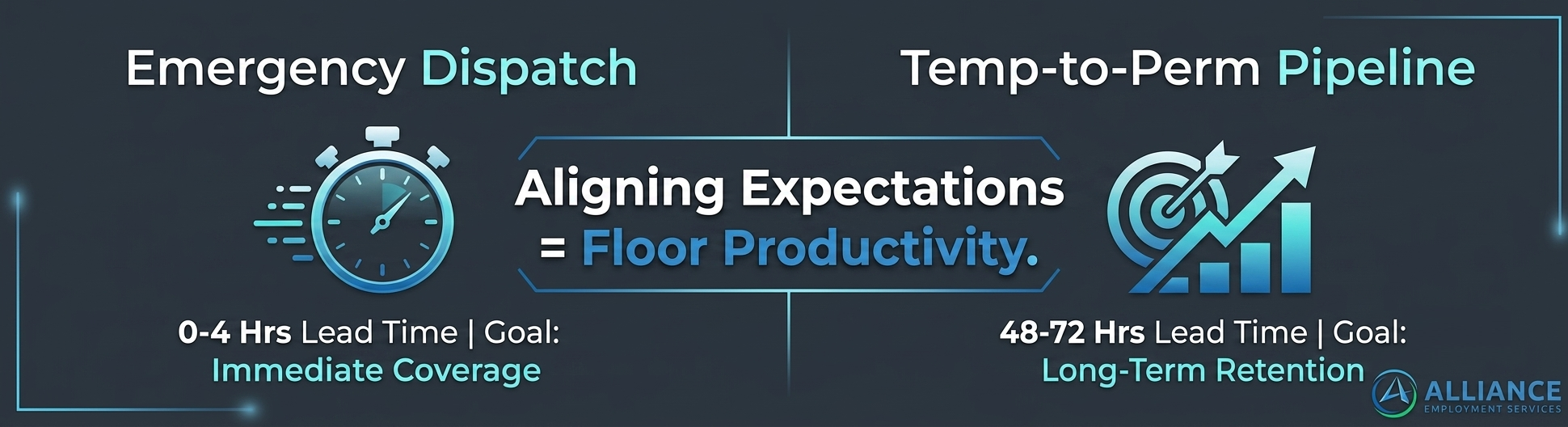
It comes down to time, not to how good the workers are.
An emergency fill comes from whoever is free right now and cleared to work. That group includes plenty of strong, experienced people. Many of the best long-term hires start there. What it cannot include is someone we matched to your shift pattern, your equipment and your site, because there was no time to do it.
It helps to know who is actually in that pool. ACSESS, the national staffing association in Canada, lists the reasons people take agency work: breaking into the workforce, bridging to a permanent job, gaining Canadian experience, building skills, changing careers, easing into retirement. That is a wide mix of people. It is not a bottom tier.
In the United States, where the industry publishes more detail, 64% of staffing employees say they took the work to fill a gap between jobs or to help them land one. Industrial work is the largest slice of the sector, at 36%. Those are American numbers, but the pattern will look familiar on any GTA floor: most of these people want steady work. They just have not been matched to it yet.
A temp-to-perm fill is the other way around. It costs you notice and gives you screening. We interview. We check skills. We ask the person whether your schedule and your work actually suit them.
That last question is what keeps people on your floor. And you cannot ask it properly at 4:30 on a Thursday.
So when a rush order lands from a site in North York, Scarborough or Etobicoke, we are protecting your shift. That is the job. It is just not the same job as building your bench.
When you call at 4:00 PM for tomorrow morning, we are looking for one thing: who is free, cleared and reliable. If you want someone who is still on your floor next year, we need to plan that together, ahead of time. The notice is what turns a shift fill into a keeper.
How do you set up two staffing tracks before peak season?
The fix is simple. Give the two order types different names. Agree on what each one is for. Then use the right one when you call.
Coverage
Same-day and next-shift orders. These protect today's production. We check that people are available, reliable, and safe to put on your floor.
Judge it on: did the line run?
Targeted temp-to-perm
Two to three days' notice or more, plus a proper brief: the shift pattern, how physical the work is, the equipment, any tickets or certifications, and what a good worker looks like to you.
Judge it on: are they still here in six months?
This is not just how we prefer to work. ACSESS lists the two jobs separately when it describes why businesses use agencies: to fill positions quickly and cover unexpected absences, and to gauge employee fit before hiring. Two different reasons. Two different orders.
Most GTA warehouses and plants are starting to forecast September through December right now. For a ramp-up that size, a few weeks of notice is worth far more than a few days. Recruiters can only work with the time you give them. And the difference between three days and three weeks usually shows up in your turnover, not in whether we fill the order.
There is a reason to plan early this year. Job vacancies across Canada rose in the first quarter of 2026, the first increase since the middle of 2022. Ontario added 8,800 vacancies, the largest jump of any province, bringing the total to 177,300. Vacancies for temporary positions were up 5%. Statistics Canada publishes the next set of numbers on September 15, just as peak season starts.
One more thing: write down which type each standing order is. Half the arguments we see happen because two people each assumed the other one knew.
What does the agency handle, and what stays with you?
Our job is easy to state. Keep your shifts covered. Keep your production moving. When an order lands at 4:00 PM for the next morning, everything we do is pointed at one thing: filling it.
That is the work, and we are built for it. A no-show, a sudden order, three people out sick at once. Emergencies happen on every floor in this business. You should be able to call us late and still run in the morning.
What we cannot do is see your next month before you do.
That part stays with you. It does not take much, and it does not have to be exact:
- A rough volume forecast for the next few weeks
- A heads-up when a new contract or product line starts
- Which months are usually quiet, and which are not
- Shift changes or line moves you already know are coming
Even loose numbers change what we can do, because they let us recruit ahead of your demand instead of behind it.
This is where most of the frustration actually gets solved. If we are only ever reacting, then every order is a rush order, and a rush order can only be filled from whoever is free that day. When you share even a rough picture of what is coming, we can screen people and line them up before you need them. Same agency. Same rates. Different result.
So the split is simple. We own completion. You own visibility. Neither side works well without the other.
One thing worth doing before you sign with any agency, ours included: check that they are licensed.
- Ontario.ca — Licensing of temporary help agencies and recruiters: since July 1, 2024, agencies need a licence, and clients are not allowed to knowingly use an unlicensed one. This page has the ministry's public list. Look up any agency here before you sign.
- Ontario.ca — Temporary help agencies (ESA guide): what agency workers are entitled to, and which duties stay with you as the client.
- Ontario.ca — Temporary help workers, agencies and host employers: how safety duties are shared between the agency and your site.
- Statistics Canada — Job vacancies, first quarter 2026: Ontario vacancy numbers, the rise in temporary positions, and the release date for the next quarter.
- ACSESS — Industry Statistics: why Canadian workers take agency work, and why businesses use agencies. ACSESS is the national association for the staffing industry in Canada.
- American Staffing Association — Staffing Industry Statistics: the 64% and 36% figures. US data, included because the equivalent detail is not published in Canada.
- ACSESS — Canadian Staffing Index: a monthly read on how many temp hours the industry is actually billing, if you want to track demand yourself.
If you want the details on how rush orders work, our temporary staffing solutions for the GTA page walks through how orders get placed and filled.
Frequently Asked Questions
Why does it feel like worker quality is dropping?
Usually it is not a drop in quality. It is a mismatch in expectations. When you order workers for tomorrow morning, we send people who are available, cleared to work, and reliable. That is what keeps your line running. If you then judge those same workers on whether they want a long-term career at your plant, they will look like a poor fit. But that is not what the order asked for.
Can a worker sent for an emergency shift become a full-time hire?
Yes, and it happens often. Just treat it as a bonus, not the plan. A proper temp-to-perm match means screening someone against your shift pattern, your equipment, and your site before they show up. Not after.
How much notice do you need for a temp-to-perm hire?
Two to three days gives our recruiters time to screen, interview, and match people to your plant instead of just checking who is free. If you are ramping up for peak season, a few weeks of notice helps far more than a few days.
Does using a staffing agency remove my company's employment obligations?
No. As employer of record, we handle payroll, remittances, and WSIB coverage for our workers, which takes a lot off your plate. But Ontario law keeps clients and agencies sharing responsibility in some areas, including certain unpaid wages, hours records, and workplace safety. Ask an employment lawyer how this applies to your operation.
How do I check that a staffing agency is licensed in Ontario?
Since July 1, 2024, every temporary help agency in Ontario needs a licence, and clients are not allowed to knowingly use an unlicensed one. The Ministry of Labour keeps a public list of licensed agencies online. Look up any agency before you sign with them. It takes a few minutes.
This article is general information about Ontario employment standards and workplace safety rules. It is not legal advice. What applies to you depends on your specific setup, so check with a qualified employment lawyer.
Plan Your Fall Staffing Now
Tell us what September through December looks like at your site. We will help you split it into rush cover and long-term hiring, so the two stop getting judged the same way.
Book a Workforce Planning Call Or call directly: (416) 892-6715 · Licensed Ontario temporary help agency · Fast deployment